Starlink hardware history: from the first round dish to Mini 2
Research & procurement notes · DELTA V by Keisei
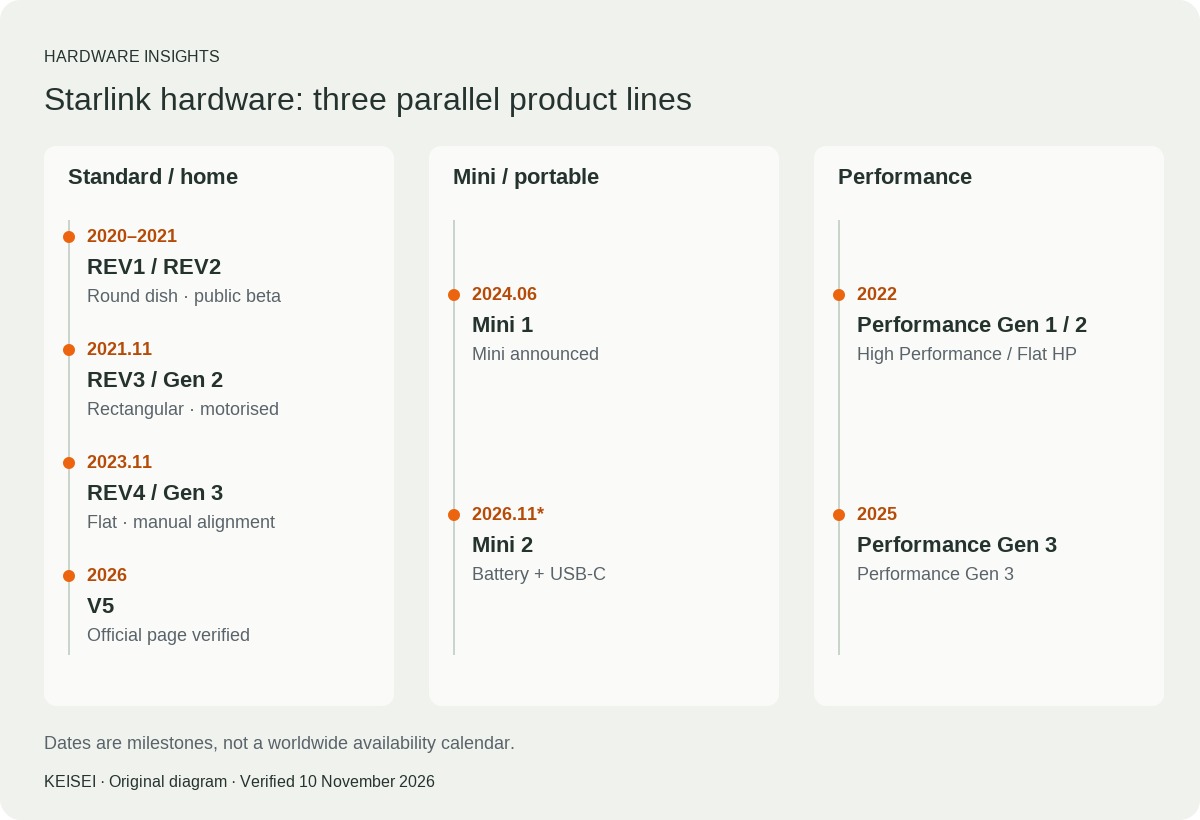
Starlink’s first customer-facing round dish entered public beta in October 2020. The hardware then developed along several branches: Standard for everyday installations, Mini for portability and Performance for demanding deployments. Mini 2 belongs to the portable branch; it is not the next generation of every Starlink terminal.
Figure 1. Original KEISEI overview. Dates combine public-beta, announcement, production and observed-page milestones; see the evidence table below. Mini 2: official page verified on 10 November 2026, not a claim about its exact first release date.
Read the family before the generation
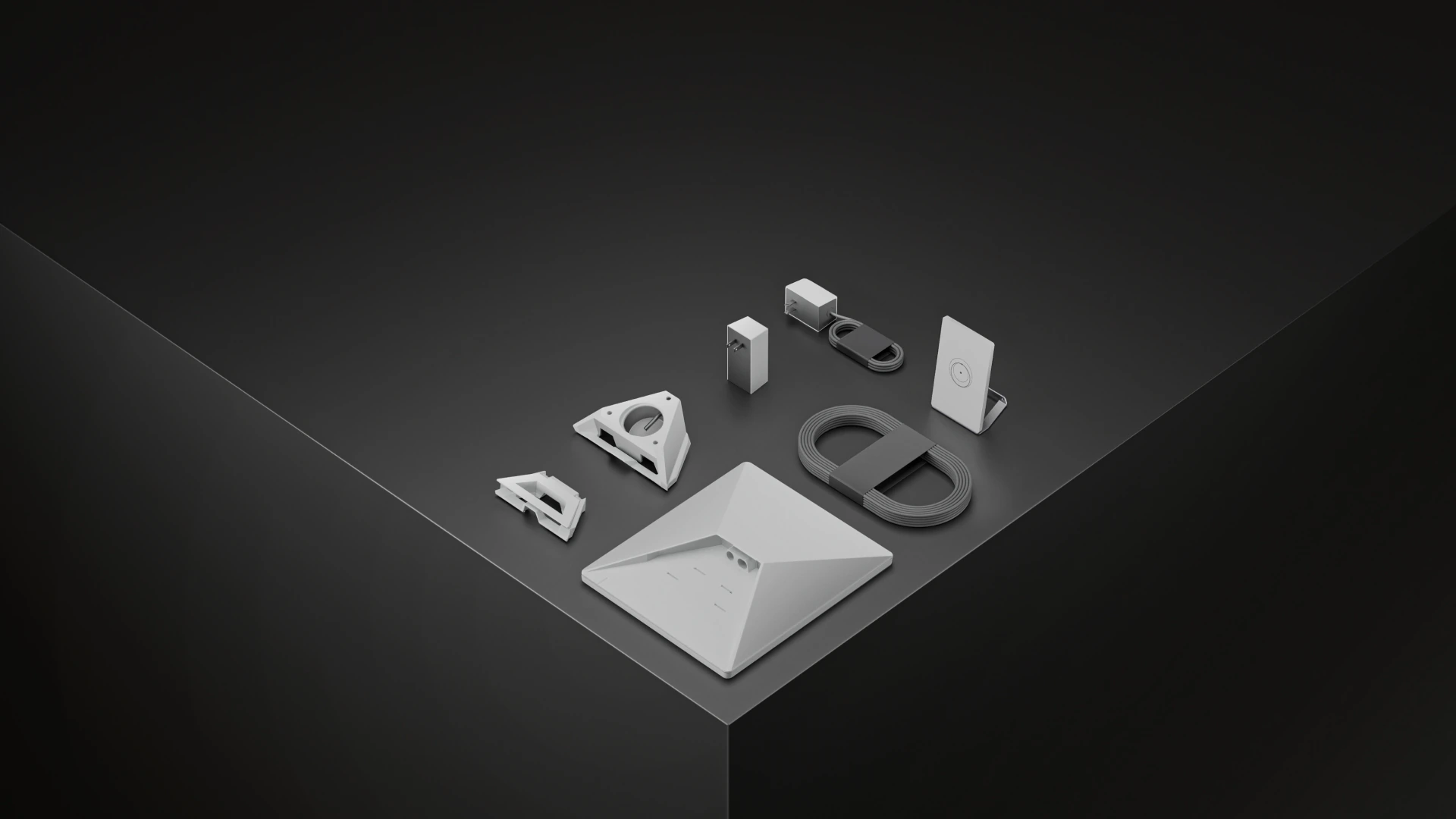
A Starlink kit contains more than an antenna. Its terminal, router, power supply and mounts may each have a different revision. The familiar “Gen 3” Standard terminal is also known as REV4/V4 in hardware discussions. A Router 3 in a box does not by itself identify the dish.
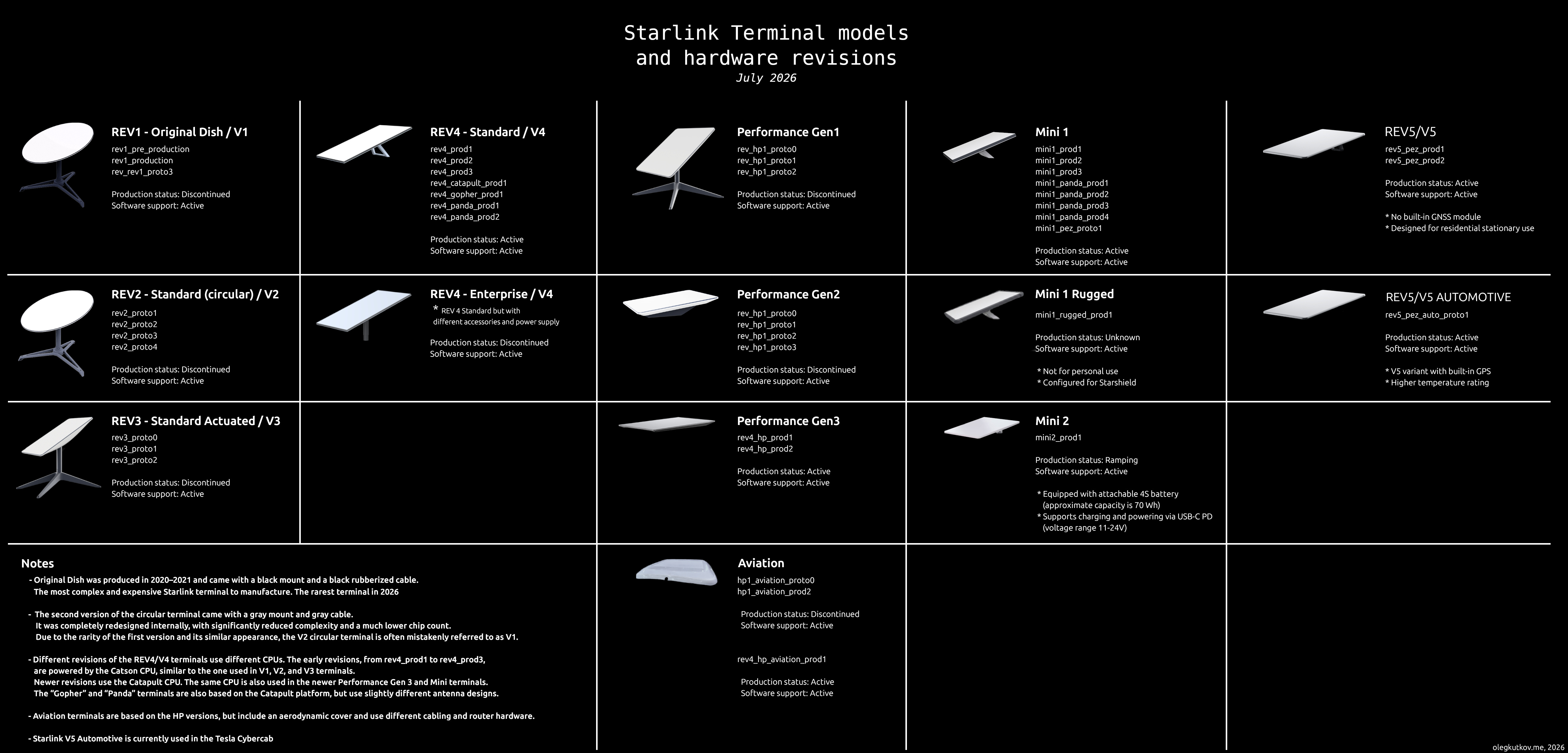
Oleg Kutkov’s July 2026 chart separates these hardware families and internal revision strings. We use it as a dated identification reference. Its production-status labels describe that snapshot, not a live stock list or a global launch calendar.
These are public milestones, not a promise that the same hardware could be ordered in every country on the same day. Where the evidence is a contemporaneous observation or a production-year record, that distinction is included explicitly.
When did each generation appear?
Date / evidence type
Terminal or family
What changed / evidence
October 2020 · public beta
Original round dish · REV1
Early beta invitation records, followed by the Starlink team’s November AMA. The beginning of this consumer-terminal timeline.
2021 · production record
Second round version · REV2
An internal redesign under a similar circular exterior. Oleg records production in 2021–2022; it is often grouped with REV1 as “Gen 1”.
November 2021 · observed rollout
Standard Actuated · REV3 / Gen 2
The rectangular, motorised terminal appears in US customer account records. Oleg’s adapter teardown independently places the new generation at the end of 2021.
2022 · production record
High Performance / Flat High Performance
A separate professional branch. Oleg records these families in production from 2022; the flat version is later named Performance Gen 2.
November 2023 · public-page observation
Standard · REV4 / Gen 3
A flat terminal with a kickstand and manual alignment. The page was observed in November; Oleg’s hands-on tests followed in January–February 2024.
June 2024 · official announcement
Mini · first generation
Starlink’s 2024 report dates the Mini announcement to June. A compact terminal incorporates Wi-Fi in the same housing.
2025 · official annual report
Performance Gen 3 + Router Mini
The 2025 report records the launch of the Performance Kit and Router Mini. Router Mini is a router, not a new Mini antenna generation.
2026 · official page verified
Starlink V5
The UK specification page lists a lightweight home terminal bundled with Router Mini. This confirms the current product identity, not its exact worldwide release day.
November 2026 · official page verified
Mini 2
The current page confirms a removable battery, Wi-Fi 6 and USB-C. We verified it on 10 November; the source set here does not establish the first global sales date.
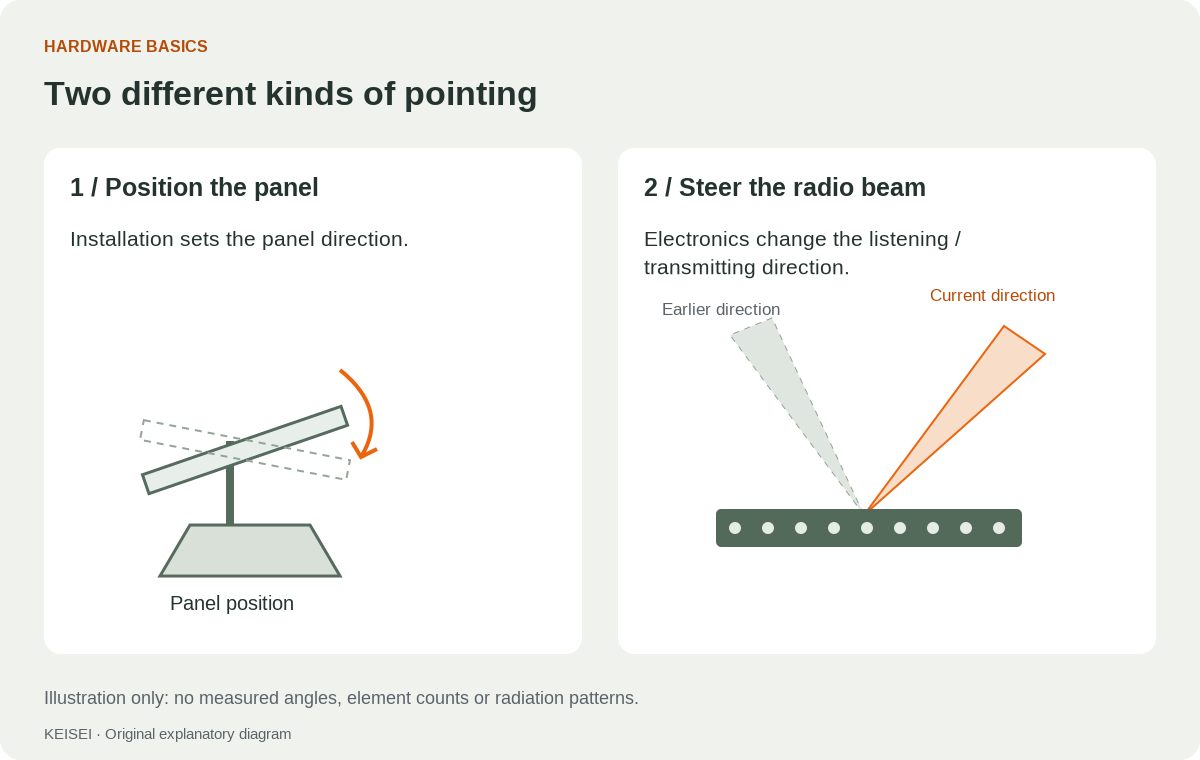
Standard traces the clearest installation story: a round terminal, a rectangular motorised design, then flatter hardware that the user positions. REV2 also shows why appearance alone is insufficient: two circular dishes can contain substantially different electronics.
Mini shifts attention to what the user carries and powers. In the first Mini, the antenna electronics and Wi-Fi router share an enclosure. Mini 2 adds a battery-based setup; Starlink advertises up to 4.5 hours of operation and 60 W USB-C charging. Those are manufacturer claims, not our battery test.
Performance follows a different set of priorities. The current official Gen 3 page emphasises rugged construction, mobility and demanding environments. Its generation count runs within the Performance family, so “Performance Gen 3” and “Standard Gen 3” do not name the same hardware.
Mini X, Router Mini, REV and Gen: four different clues
Mini X is a kit configuration: the official regional page lists a Mini terminal plus an additional Router Mini. It should not be drawn as the successor between Mini 1 and Mini 2. Enterprise likewise appears in Oleg’s chart as a REV4-based configuration with different power and mounting equipment.
A hardware revision such as mini1_panda_prod3 is more specific than the commercial family name. It matters for board-level diagnosis and compatible parts, but does not automatically mean a new retail generation or faster internet. Satellite versions called “V2 Mini” are a separate subject: they are spacecraft, not the portable terminal.
Start with the terminal’s exact product name and hardware-version string, then record the router and power-supply models separately. Use the device label, kit contents and the Starlink app’s available diagnostic information together. A box nickname or the shape of the dish is only a starting point.
For a replacement or purchase comparison, keep installation method, connectors, power requirements and intended country of use in the same checklist. A later date on this diagram alone does not tell you whether an existing mount, cable or service arrangement will work.
Official specifications, independent research and our purchasing guidance are identified separately. Oleg Kutkov is a cited independent researcher, not the author of this site. Rumours, when covered, are labelled unconfirmed and updated when primary evidence appears. Specifications and regional kit contents can change.
DELTA Vby Keisei Co., Ltd.
Hardware knowledge for better purchasing decisions.
DELTA V by Keisei Co., Ltd. connects hardware research with cross-border B2B sourcing. For model selection, regional configurations or a purchasing enquiry, contact our team.